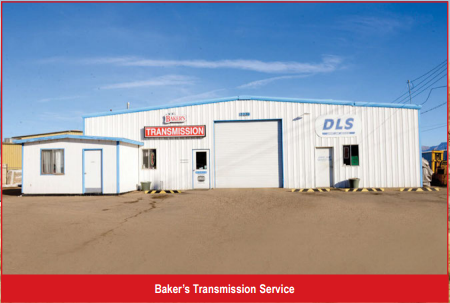
Lately a substantial number of transmission shops have begun to expand into general repairs. But at Baker’s Transmission Service, LLC in Grand Junction, Colorado, the expansion is in an entirely different direction.
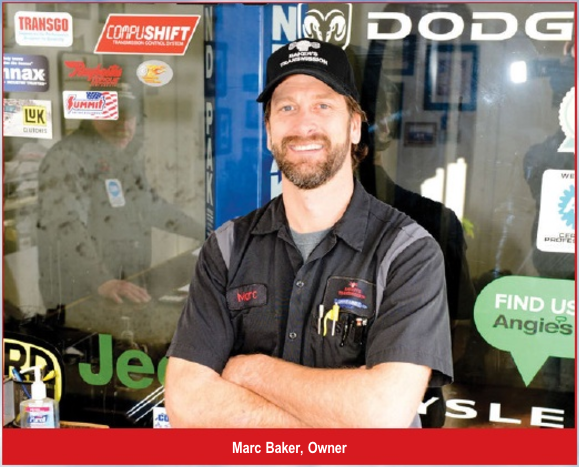
That’s because Baker’s isn’t just a transmission shop: They’re a one-stop drivetrain repair center, featuring transmissions, differentials, driveshaft and axle repair… and torque converters. And, according to shop owner Marc Baker, they have all the work they can handle.
Baker’s started out as a transmission shop. So how did they get involved with torque converters? “A company I used to work for in Denver rebuilt converters, and they decided to close shop,” says Marc. “They had all this equipment, and they called me and said, ‘Hey, we’ll make you a terrific deal if you’ll buy everything.’ I thought about it a while and said ‘okay.’
 “Once I had it, the question became, ‘What am I going to do with it?’ I didn’t know how to rebuild torque converters. The deal included sending their technician, Danny Rice, to show me how to use everything. I figured I’d have to hire someone, so, while he was here, I asked him what he was planning to do. He said, ‘I don’t know,’ so I asked him to work for me.
“One of the best things about having a converter shop in house is the ability to know… there’s no more guessing about whether there’s a problem in the converter or not. Being able to cut the converter open and look inside answers a lot of questions.
“It’s increased our understanding of what’s going on inside the unit… what’s failing… and what’s trending. We look in the pan and we know what we’re looking at. That helps us educate our customers and provides us with a better approach for selling the job.”
 It’s only been a little over a year since Marc added torque converters to his business, but it’s going pretty well.
Performance Converters
A big part of the focus at Baker’s is on building performance units, and their ability to build custom converters has helped increase their business. One of the ways Marc serves these customers is to guarantee the first stall change: “If the stall isn’t right for their configuration, we’ll replace it free,” explains Marc.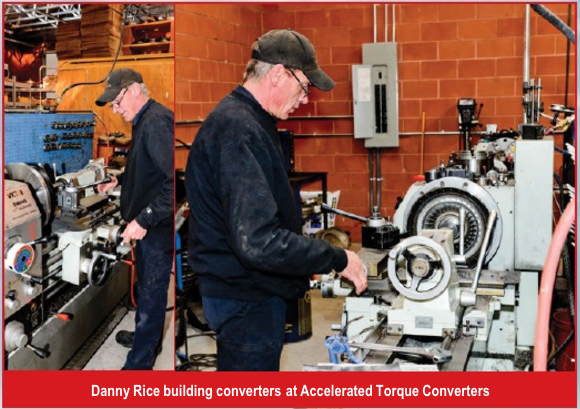
The trick is to get customers to be honest about their engines: “Danny tells them, ‘If you lie about how much horsepower your engine’s producing, we’re going to know.’ They’ll claim they’re producing 500 horses when it’s really closer to 350.
“But that’s an advantage of dealing with us. We’re here to make the modifications you need. It’s not like a mail order business where, if the first one doesn’t work, you can buy another one. We’re here to work with you.”
Having the custom converter shop in house has begun to feed the transmission shop: Customers come looking for a performance converter and they end up bringing their transmission in for a rebuild or modification.
And since the converter shop is still fairly new, business is still growing. “We’re really just starting to advertise the converter business and build that up,” explains Marc. “Like any business, things don’t happen fast.” But they appear to be moving steadily in the right direction.
Outside Converter Sales
While there are a few other transmission shops nearby, Marc hasn’t really tried to sell them torque converters yet. “Right now we aren’t doing a lot for other shops,” he says. “We prefer to focus on our performance converters.
“Most other shops are more interested in finding the cheapest converter available. We don’t do that with our transmissions and we’re not interested in going that way with our converters.
“We’re not the cheapest place in town; that’s not what we promote. We build a solid transmission that we can stand behind, and that’s what we want to do with our converters, too.
“I don’t want to compete with the mass-production converter rebuilder. Let’s face it: Transmission repair isn’t an easy business, and if you’re going to cut costs, you must cut them from somewhere. Too often that’s in the converter. I’m not interested in that: I’d prefer to build exceptional converters, even if it means I only build them for my retail customers.”
And, since converters are only a part of Baker’s overall business model, he doesn’t have to make a lot from them. By building a superior torque converter, he can support his whole business model, reducing comebacks and improving customer satisfaction. So the business as a whole profits.
Something else that probably helps their business is the region: Baker’s Transmission is in Colorado: Their customers drive on mountainous roads and a lot of their vehicles are work trucks.
Those customers know just how much they put their vehicles through, and they want to be sure their transmissions and torque converters will stand up to the rigors of the day. That makes it easier to sell a job built to extraordinary specifications.
Marc’s History
Marc got his start in transmission repair when he was 17 years old. “My dad bought an old Trailblazer to go 4-wheeling,” he says. “It needed a trans; since we were both going to be using it, he said I had to help install the tranny. So we bought an exchange unit from a shop nearby. Once we got it installed, the shop owner wanted us bring it by so he could check the adjustments to validate the warranty.
“We installed it and Dad brought it back for the check. The guy asked, ‘What’s your kid doing? He looked pretty into this.’ At the time I’d been working at a grocery store. My dad came home and said, ‘That guy at the trans shop is interested in hiring you.’
“I didn’t have any tools… didn’t know anything about transmissions… but I went down and talked to him. He said, ‘I have all the tools you’ll need; I’ll put you on as an apprentice and pay you piecework. You just have to show up every day and I’ll teach you what you need to know.
“The first week I worked 45 hours and made $125. I thought ‘I don’t know if I can do this.’ For the next year and a half I worked nights at the grocery store and worked the shop during the day. Then I quit at the grocery store and started working the shop full time.”
He continued working there for another year and a half, and then moved on to other shops, getting more and more experience along the way. “I’d tell the shop owner I had more experience than I did just to get the job,” he says.
One thing Marc is firm about: He’s always preferred to be a swingman rather than exclusively a rebuilder. “I really enjoy doing the job from front to back,” he says. And, as he points out, “I’m more valuable to an employer if I can do everything.”
It’s a business model that he uses to this day. “I have two technicians in my shop. They diagnose the cars, pull the units, rebuild them, reinstall them, and road test the vehicles to make sure everything’s working okay,” says Marc. “I think that’s the way a transmission shop should operate.”
Complete Drivetrain
While their converter business is taking off, Baker’s Transmission is, first and foremost, a transmission repair shop. They opened on February 1, 2006, so they just celebrated their 10th anniversary.
In addition to being a transmission shop and a torque converter shop, they also offer driveshaft and axle repair under the name Drive Line Service.
Drive Line Service was a separate company that operated for about 30 years in one half of a larger building. Marc needed a new location for his transmission shop, so he leased the other half of the building.
“The owner wasn’t too thrilled about having a transmission shop sharing his building, but we worked out our issues,” says Marc. “I assured him that, if one of his customers came through my door, I wouldn’t try to poach him,” says Marc. “And he did the same for me.”
The two ended up building a terrific relationship, neither stepping on the others’ toes and providing each other referral work.
And having a driveshaft specialist right there made it easy for Marc to farm out some of the jobs he didn’t want. “I never liked installing U-joints anyway, so having them there was a blessing. I’d just take the stuff over and it’d get done.”
When the owner of the drivetrain shop decided to get out, Marc approached him and they came to an arrangement. “The next thing I know I owned a driveshaft shop!”
Interestingly, one thing that Drive Line Service won’t repair is CV-joints. That’s because it’s too cheap to buy complete axles through conventional parts stores. There’s just no profit in repairing them.
But anything else in the drivetrain — from the transmission and converter, to the driveshaft, to the differential — Baker’s is equipped to handle it.
ATRA and TCRA
From the time he opened his doors, Marc has been an ATRA Member. “The guys on the ATRA HotLine are always real helpful about trying to get us the answers we need. ATRA plays such an important roll in this industry!”
According to Marc, ATRA’s especially important to shops like his that are away from the big cities, because ATRA’s technical specialists will hear about problems long before they show up out in the country.
When he calls the ATRA HotLine, Marc’s learned it’s a good idea to let them know what he needs, right up front. “I called them and asked, ‘Who can I talk to about a CAN Bus?’” and they put me right through to a specialist who was able to answer all my questions.
Before they call the HotLine, Marc insists that his technicians go through all the basic checks. “I ask, ‘Did you put a gauge on it?’ I want to make sure that we’ve done everything possible before we start asking for help.”
Now that he’s also operating a torque converter business, he’s also become a TCRA Member.
“We’re fairly new to TCRA, but what a great bunch of guys! I made it to their seminar in Kentucky and it was terrific to be able to speak with other Members. They were really open to what I’m doing; I spoke with a few other guys who were trying something similar. Quite a few seemed excited that I wanted to be a part of the Association.
“I received a lot of information and was able to provide some feedback because of my transmission experience. I’m really looking forward to attending this year’s program in Seattle.” (See page 41 for TCRA info)
Off-Road Motorcycle Riding
While Marc stays busy at work, he tries set aside a little time to ride his motorcycle. He’s a member of a local group, the MTRA — Motorcycle Trail Riding Association. “I’m an avid dirt biker; the club focuses on land issues and trail maintenance. We try to keep areas open to dirt bikers and make sure other enthusiasts are aware of what they shouldn’t be doing.
“I’m pretty well known in the motorcycle world; I race motorcycles, so people get to se me on that front, too.”
And we’re not just talking about local racing: “Last year my wife and I traveled to Romania and I took part in a 5-day, off-road event called ‘The Red Bull Romaniacs.’ I did well; finished 21 out of 166.
“It’s a pretty grueling race, and it was a lot of fun to meet people from around the world who enjoy the same hobby.”
Transmission repair… torque converters… drivetrain… and even off-road motorcycle racing. No doubt about it: Marc keeps himself busy. And he provides a stellar example of how a shop can be successful in several disciplines without taking on general repair. We wish him the very best.