
The A6 series transmission found in Hyundai and Kia applications has been with us since 2009. However, they have not been a frequent attraction in our transmission shops until recently. Many of these units have been replaced with factory-remanufactured transmissions at a dealership or a transmission shop.
With the cost of the OEM unit rising, the prospect of rebuilding these units becomes a more attractive option. Before we take the rebuild path, we need to get up to speed with patterned failures that bring these units in for repairs. Let’s look at what we need to know to get these units out the door correctly.

UNIT IDENTIFICATION
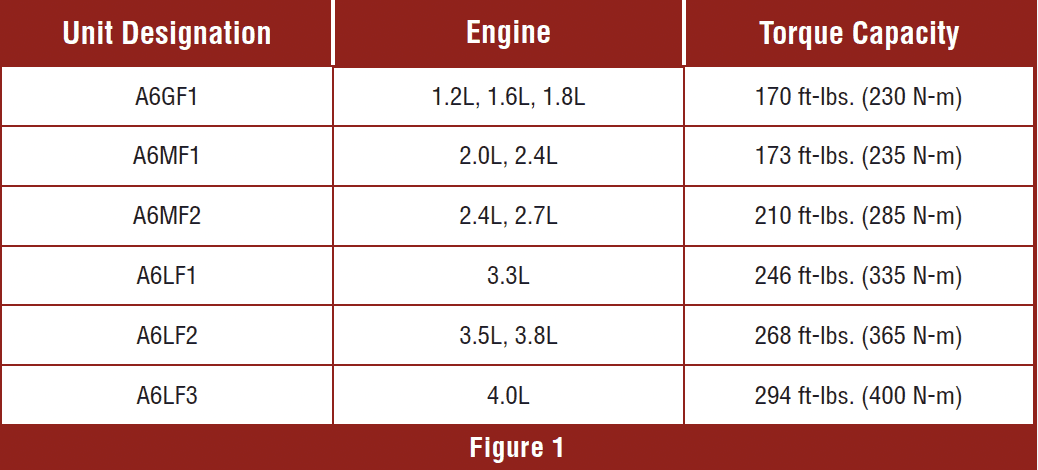
Knowing which unit you are working on is essential in ordering the correct parts needed for repair. The A6 transmission comes in three variants; the A6GF, A6MF, and the A6LF. Within each variant, there are different models based on input torque. The final digit indicates the different torque levels (figure 1).
 This unit has enough variations to keep you in trouble should you roll the dice on a used unit that ‘looks’ like it will work. My suggestion would be, don’t do it! It is mandatory that you take the time to accurately identify the transmission that came with the vehicle and compare it with your target replacement. Even if it came from the OEM source, do not let go of the core unit until you have verified beyond a shadow of a doubt that you are installing the correct replacement unit. The same advice holds when replacing internal hard parts. Internal components vary from unit to unit. When ordering parts from a non-OEM source, always match the replacement parts with the ones from the original unit to ensure they are correct.

ON THE OTHER SIDE OF THE FLYWHEEL
Shift quality issues rank high on the list of complaints associated with these transmissions. While there are enough items to address inside the transmission, it is extremely important to pay close attention to engine-related concerns first. Issues with the engine range from cam/crank timing sensors and components failing or malfunctioning to mechanical components breaking. I recommend recording a movie of engine data while a transmission malfunction occurs and watching for problems, especially before and during commanded shifts.
 There are engine warranty-related concerns that need to be considered with some specific models. Here is a recent list of vehicles that fall under this category:
- The model Year 2013 and 2014 Hyundai Sonata vehicles equipped with 2.0-liter and 2.4-liter gasoline direct injection (GDI) engines manufactured at Hyundai Motor Manufacturing Alabama.
- 2011-2019 Hyundai Sonata Hybrid sedans
- 2016-2019 Hyundai Sonata Plug-In Hybrid Sedans
- 2010-2012 Hyundai Santa Fe SUVs
- 2010-2021 Hyundai Tucson SUVs
- 2014 Hyundai Elantra coupes
- 2014-2016 Hyundai Elantra sedans and hatchbacks
- 2014-2020 Hyundai Elantra GT hatchbacks
- 2012-2017 Hyundai Veloster hatchbacks
- 2011-2020 Kia Optima Hybrid sedans
- 2017-2020 Kia Optima Plug-in Hybrid Sedans
- 2011-2013 Kia Sorento SUVs
- 2011-2013 Kia Sportage SUVs
- 2010-2018 Kia Forte sedans
- 2010-2016 Kia Forte Koup coupes, and 2012-2019 Kia Soul hatchbacks, all with 2.4-liter Theta II MPI Hybrid, 2.4-liter Theta II MPI, 2.0-liter Nu GDI, 2.0-liter Nu GDI Hybrid & Plug-In Hybrid and 1.6-liter Gamma GDI four-cylinder engines.
Reach out to the OEM service department with your VIN to see if the vehicle you are working on is affected.
There are complaints of engine failure. However, issues with the engine cam-to-crankshaft timing are more subtle. Faults on this level can affect shift quality and torque converter clutch scheduling. Engine-related problems are known to cause the following complaints:
- Flaring or harsh shifts
- Delayed or harsh garage shift
- Shudder complaints that can be mistaken for TCC shudder
 The A6 series transmissions freeze all adaptive learning whenever a code is stored in a powertrain control module. Also, shift quality and scheduling may be altered as a part of powertrain management relative to codes stored. As a result, scanning and recording all codes in all modules is essential.
INSIDE THE BOX
The A6 transmissions are showing patterned failures. One common concern is front pump leaks. The pump seals on virgin units tend to blow out with no apparent cause. However, a closer look reveals an interesting find. The area on the stator side of the pump where the front seal drain passage runs is obstructed by one of the pump bolts (figure 2)! A known fix has yet to be established; however, creating space around the bolt area should remedy this problem.
We also received complaints about the Underdrive Support bolts coming loose (figure 3). If the bolts work their way out far enough, they will interfere with the return of the Underdrive piston, causing the clutch drag. The issue causes 3-4 and 4-3 shift complaints and engagement into drive, slipping, and burnt clutches. We recommend using a non-permanent thread-locking compound when installing these bolts.
 Another area of concern is underdrive piston cracks. Depending on the severity of a crack, issues can vary from no forward engagement (movement in reverse okay) to intermittent no forward, downshift neutralizing into 4th gear from 5th or 6th gears, and/or burnt clutches. Inspect the seal grooves and the piston body for issues and replace them as necessary.
Center support bearing failures are becoming common as these units age. In some cases, you can detect a fault during a test drive. If you have a bearing noise that varies relative to road speed, it could indicate that this bearing is bad. Always disassemble and inspect this bearing when the unit is being assessed for repair on the bench.
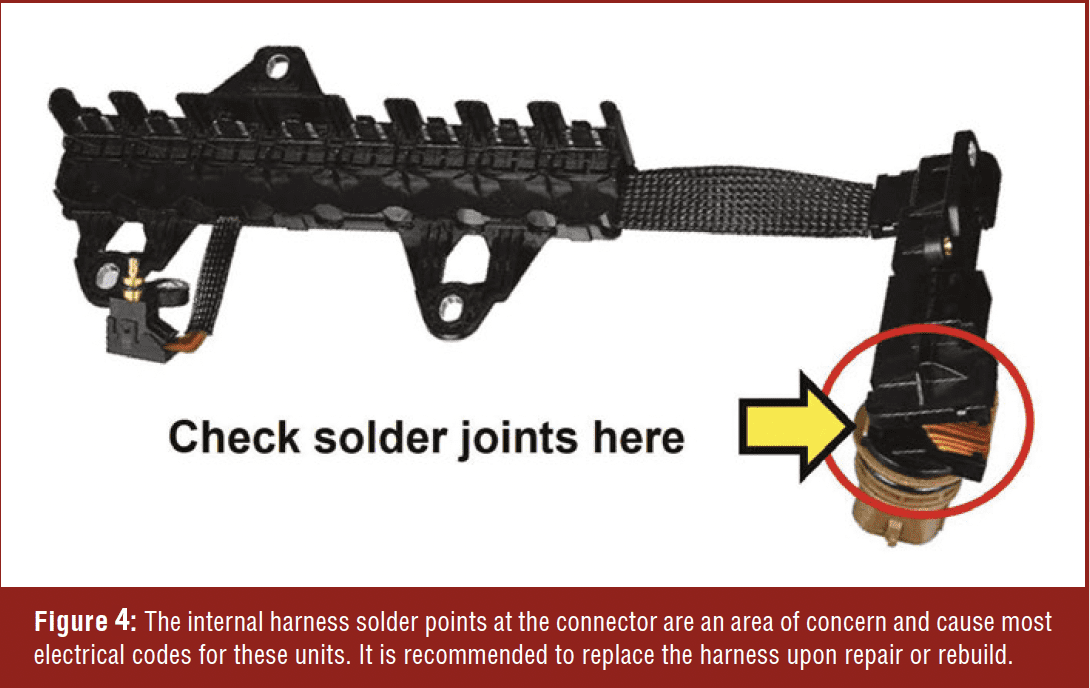
 The internal wiring harness is considered to be a high-failure component. Its design is prone to issues near the case connector end (figure 4). Solenoid circuit codes, speed sensor codes, and transmission fluid temperature sensor codes are possible. There are aftermarket and OEM replacements available for the various models. Order by year, make, and model.
Another area of concern is the Transmission Fluid Temperature sensor. A faulty sensor can cause early, firm shifts, no lock-up command, diagnostic trouble codes, and possible failsafe shift to 4th gear only.
Model years 2009 through 2012 have a stand-alone temperature sensor. 2013 and up have the sensor integral to the internal wiring harness. The later harness with the sensor services the earlier versions and is a recommended upgrade.
 While speed sensors are not a common concern, replacing them can be. The input and output speed sensors are replaced as a set. They are bolted to the case and are accessible by removing the valve body. However, be aware that you must properly identify the speed sensors to order the correct set for your application. The sensors and harnesses are color-coded for visual identification purposes. Refer to figure 5 to identify them correctly.
THE VALVE BODY
Valve body bore wear is a significant issue with these units. Don’t let the mileage fool you! The valve bodies can show substantial wear in as few as 40k miles. Varying shift quality complaints are commonly associated with worn valve body bores. If the transmission fluid is clean, replacing or repairing the valve body can be an appropriate fix.
 All bores on this valve body are subject to wear. So, it is essential to check all bores for issues. However, the Reducing valve bores love to wear out even with low miles. These units use two Reducing valves (Figures 6a and 6b). They are responsible for altering pressure to assist in smooth shifting. Do not move the adjustment screws! Remove the valve train and inspect the bores for wear. There are aftermarket repair kits available for these valve bores. Also, new valve bodies are available through Hyundai and Kia for all models.
It is hard to determine future patterned failures for units as they age. However, it is crucial to be aware of known weaknesses so you can deliver the goods back to the customer correctly the first time.