The Mitsubishi DSG (often referred to as the Duonic) is the first fully automated transmission from Mitsubishi for medium-sized trucks (20,000 lbs and up) and was first introduced in the Canter trucks in 2011. It was a joint venture between Mitsubishi and Daimler AG, with Daimler owning around 89%. It comes with two engine options: A diesel engine or gas/hybrid.


The DSG is a dual-clutch 6-speed transmission and uses two wet clutches to drive the two input shafts; one clutch for the even-numbered gears and the other clutch for the odd (figure 1). The dual clutch design has a few benefits over both a standard transmission and automatic. With it, you get the efficiency of a standard transmission and the functionality of an automatic. It’s been around for years in cars so it was only a matter of time before we’d see it in trucks.
For a truck it’s pretty modern. It uses an Electronics Stability Program (ESP) for better handling and comfort and there are ‘creature comforts” in the cab that make it a better driving experience.


The valve body and the pump are integrated in this unit and sit in the very front, right behind the flywheel. Behind the pump and valve body are the two wet clutches. This system (pump, valve body and wet clutches) is self-contained and uses ATF-SP III for operation and lubrication and has a capacity of 4.5 quarts. The gearbox section of the transmission is also self-contained and uses API GL-3 SAE-80 gear oil with a capacity of 3.7 quarts (we’ll get into more of that later).
Other than having two input shafts the DSG looks about the same as any other standard transmission. One thing, though, that you’ll notice is an aluminum box mounted on top of the gearbox section. It’s referred to as a “shift control box” and controls the shift forks as it shifts from one gear to the next. Pay careful attention to the words “NO STEP” on the top of the shift control box. It’s a bit fragile and you risk damaging it if you step on it or place something heavy on it.
The control box contains both the actuator pistons that move the rails back and forth and the solenoids that control the actuators and the rail position sensors. This unit has three sets of forks and sliders to acquire the six speeds. You will also see that the DSG has two output speed sensors. Even though this transmission has a mechanical park gear system inside, it also has the E brake system attached to the output shaft.

The same unit comes in 2WD and 4WD in both the FE and FG models, however the differential ratio may vary.
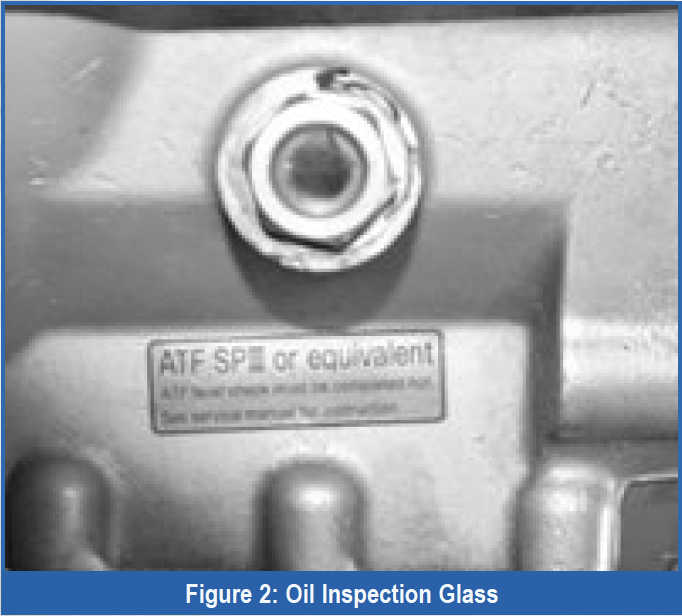
Checking the fluid level is pretty easy on the unit. The front has a sight glass, like we’ve seen on motorcycles for years (figure 2). To check it you just make sure the fluid is about half way up the sight glass. The rear gear box is like any other standard transmission; it uses a fill plug (figure 3).
WARNING: Figures 4 and 5 are the example locations of the bolts that hold the fork for the 4-1-R synchronizer mechanism. DO NOT mistake these bolts for fill plugs (they are 12 point bolt heads).
The other problematic area is in the pump cover. Both the 2-4-6 and the 1-3-5-R solenoids (figure 6) are located on the pump cover. It is very important to install the correct harness connector to its location. Failure to do so may cause erratic/binding issues or even transmission failure.
Do you remember, back in the day, the confusion in crossing the TCC solenoid connector and the EPC connector in the Ford AX4N? Line pressure would be crazy and the TCC would be pulsing at idle. It’s the same thing with this, so be careful.
To avoid mixing up the harnesses pay attention to the wire colors (Figure 7). The outer solenoid controls the outer clutch the large clutch pack, which applies/controls the 2-4-6 gears. The most inner solenoid controls the inner clutch and applies the 1-3-5-R. Just imagine the nightmare of having to pull this unit out to correct this simple mistake.
Last but not least (and the most important part of this unit), the shifting mechanism (Figure 8). It’s a relatively simple design but complex at the same time. Make sure that these shifting rods and solenoids are clean, it’s important for transmission operation.
The electronic pressure control shifting mechanism includes the shifting rods, pressure control solenoids and the housing (Figure 9). The internal actuator rails need to be polished and moving freely with no scratches or nicks or shifting issues will occur (Figure 10).
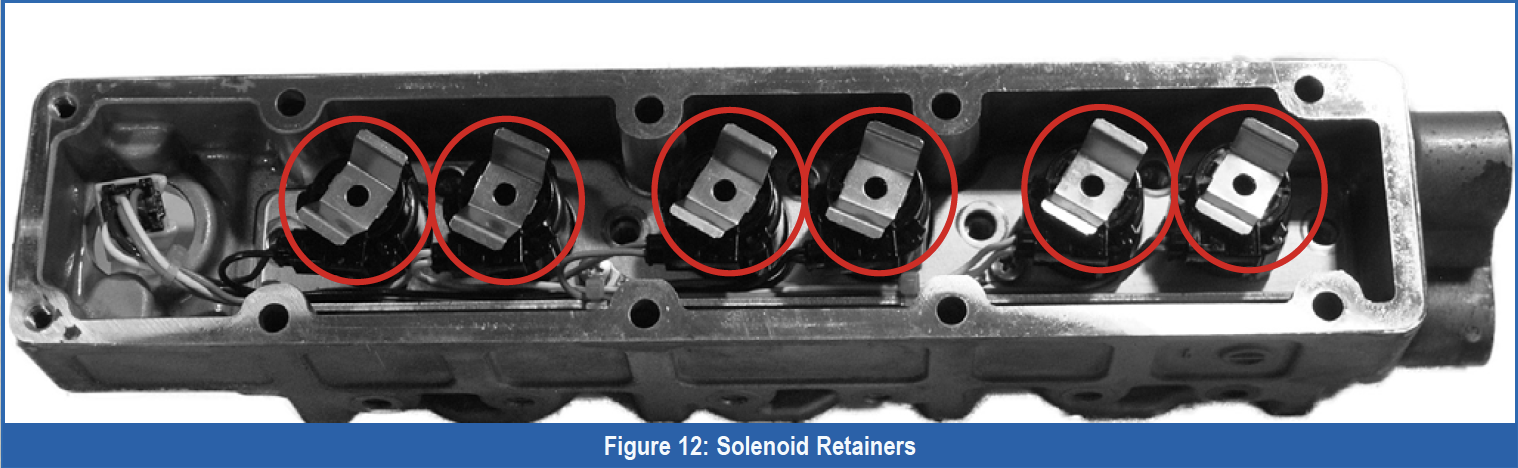
There are six solenoids that execute the shifting operations. These solenoids are PMW controlled by the computer for a smooth shifting transition between the gears (Figure 11). The solenoids resistance is 4 ohms to 6 ohms, across the board. Each solenoid has a pressure retainer on top (Figure 12) that secure the solenoids once the cover is in place.
This is just the beginning of dual-clutch units we’re likely to see in truck applications and as these become more popular, you can bet we’ll cover it right here… and that’s how she rolls.