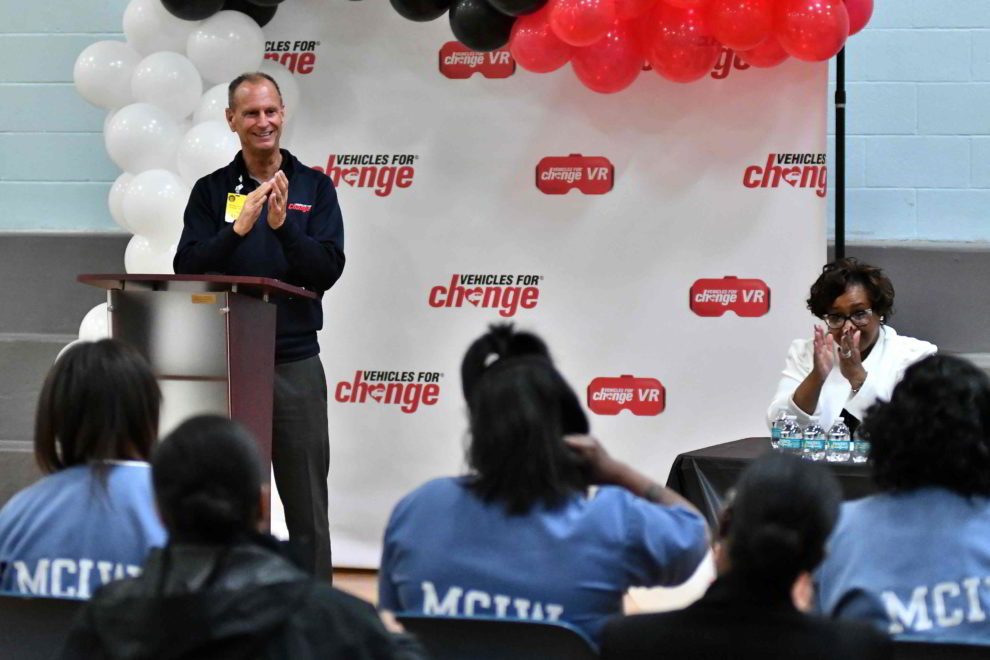
Women incarcerated in a Maryland prison are learning auto mechanic skills through the first-ever virtual reality training program, and within five years, 20 jails across the country will implement similar programs.
The first Vehicles for Change auto mechanic virtual reality training program is in full swing at the Maryland Correctional Institution for Women in Jessup, Maryland. With the use of virtual reality training, the women earn Vehicles for Change Virtual Reality certification. Five people graduated from the first class, and the second class is now underway.
Vehicles for Change state-of-the-art, interactive, virtual garage is training the next generation of auto technicians using a curriculum created by well-trained master technicians/instructors.
Skills include:
- How to use an auto lift
- How to complete an oil change
- How to replace a set of brakes
- How to remove and replace a tire using a tire changing and tire balancing machine
The VFC VR training provides the groundwork for a career in the auto mechanic field. This immersive technology is being used to provide transformative skills training that allows these women to gain employment upon release. Affording women this opportunity gives them the chance to earn a livable wage and reduces the chance of reoffending, therefore lowering Maryland’s recidivism rate. Vehicles for Change President Marty Schwartz explained, “Skills training like this is usually very expensive. However, virtual reality training cuts costs by more than 75% while still providing instruction on basic auto mechanic skills. “
Vehicles for Change hopes to expand the VR training program to 20 more locations across the country in the next five years.
Vehicles for Change is a unique nonprofit and the first of its kind in the nation to utilize virtual reality training in prisons to expand its mission across the United States. With the help of this technology, Vehicles for Change plans to expand and implement the program in prisons across the country. VFC is the only organization that addresses generational poverty and recidivism while filling a huge void in the auto industry. Virtual reality training will enable VFC to expand and substantially fill the crucial need for trained mechanics. VFC President and CEO Martin Schwartz designed the virtual automotive program to address yet another problem as well, which is limited job options for former prisoners. “This is a win-win for everyone because returning citizens can take jobs that the automotive industry has been struggling to fill. “
About Vehicles for Change
Vehicles for Change accepts, and repairs donated cars and awards them to pre-qualified families for as little as $950, enabling low-income families to become self-sufficient. A nonprofit organization, VFC receives 99 percent of its car donations from the public. VFC car donors gain a substantial tax advantage that is unavailable to most other charities.
Every car we receive isn’t just a vehicle; it’s a beacon of hope, a promise of a brighter future, and a lifeline to struggling families.
For additional information:
Vehicles for Change, https://www.vehiclesforchange.org/