Remember when louvers were an add-on to make your car look cool? Of course, in sunny regions, they keep the interior of the car cool and the sun off the backs of the passengers riding in the rear seat of your 1986 Camaro! While they still add flare to a vehicle’s appearance, now they serve a functional purpose and have a different name; shutters!
Adjustable shutters, formally known as active shutters, are placed in front of the vehicle radiator to alter airflow and reduce overall drag on the vehicle as it goes down the road (figure 1). Other names you may hear include active aero louvers, active air shutters, and active air louvers, to name a few.

 With the shutters closed, the typical vehicle enjoys a 9 percent decrease in drag. The added efficiency averages out to an increase of one mile-per-gallon saving! Needless to say, automotive design engineers are eager to add shutters to as many vehicles in their lineup as possible to help meet the new US government mandates for improved fuel mileage. It seems like a no-brainer; however, some things can and do go wrong with these shutters. This article will examine active shutter systems and how they affect transmission and vehicle operation.
HOW THE SYSTEM WORKS
Active shutters have been in production vehicles on a significant scale since 2013. All OE manufacturers control the shutters in the same general manner. The shutters are commanded open under the following conditions:
- The vehicle is over temperature
- Transmission is over temperature
- When the cooling fans are commanded ON
- Slower vehicle operating speeds
- Failsafe operation
The shutters are commanded to be closed under the following conditions:
- Higher speed vehicle operation (typical 35 mph and above)
- Vehicle warm-up (not all manufacturers)
While all manufacturers use the same basic framework, each one brings its unique features. For example, each manufacturer uses an algorithm to control the shutter operation based on vehicle operating conditions and ambient temperature. Therefore, the following sensors play a major role in the proper operation of the active shutter system:
- Coolant temperature sensor
- Transmission fluid temperature sensor
- Ambient air temperature sensor
- Vehicle speed sensor
Manufacturers may include other sensor input data to determine shutter operation. Common programming strategies are also included to ensure safe vehicle operation and prevent shutter damage. For example, active shutter systems will command the shutters to remain open under the following conditions:
- Freezing temperatures to avoid damage from ice and snow.
- Temperature sensor-related DTCs.
- Certain vehicle speed-related DTCs.
In short, the PCM or a related module will provide control input data to command the shutters open and close as needed.
Here’s a closer look at some popular manufacturers who use active shutter systems.
General Motors: GM is at the top of the list of manufacturers, with over 20 cars and trucks equipped with an active shutter system (figure 2). I recommend assuming that models 2015 and later have shutters unless you verify otherwise!
 It is important to note that the check engine light on GM applications will illuminate for codes related to the shutter system. Codes are generated through the LIN BUS network. For example, U1510 (Lost communication with Active Grille air shutter actuator) is a common failure code indicating a fault in the active shutter management. Anything from obstructed shutters to a bad shutter motor can cause this code. The most common repair involves replacing the assembly since neither the motor nor the shutter housing is sold separately.
Later model applications often have an upper and lower shutter system. The computer strategy uses powertrain and communication codes to identify performance issues.
Ford and Lincoln: Ford equipped several cars and trucks with active shutter systems with more makes and models to come. By 2016, most vehicles from the CMAX to the F-150 had active shutters. While earlier systems were a simple open/closed design, the latest Ford shutter system can have up to 14 preprogrammed positions between open and closed, providing a broader range of vehicle operation using the aerodynamic advantages while maintaining cooling capacity.
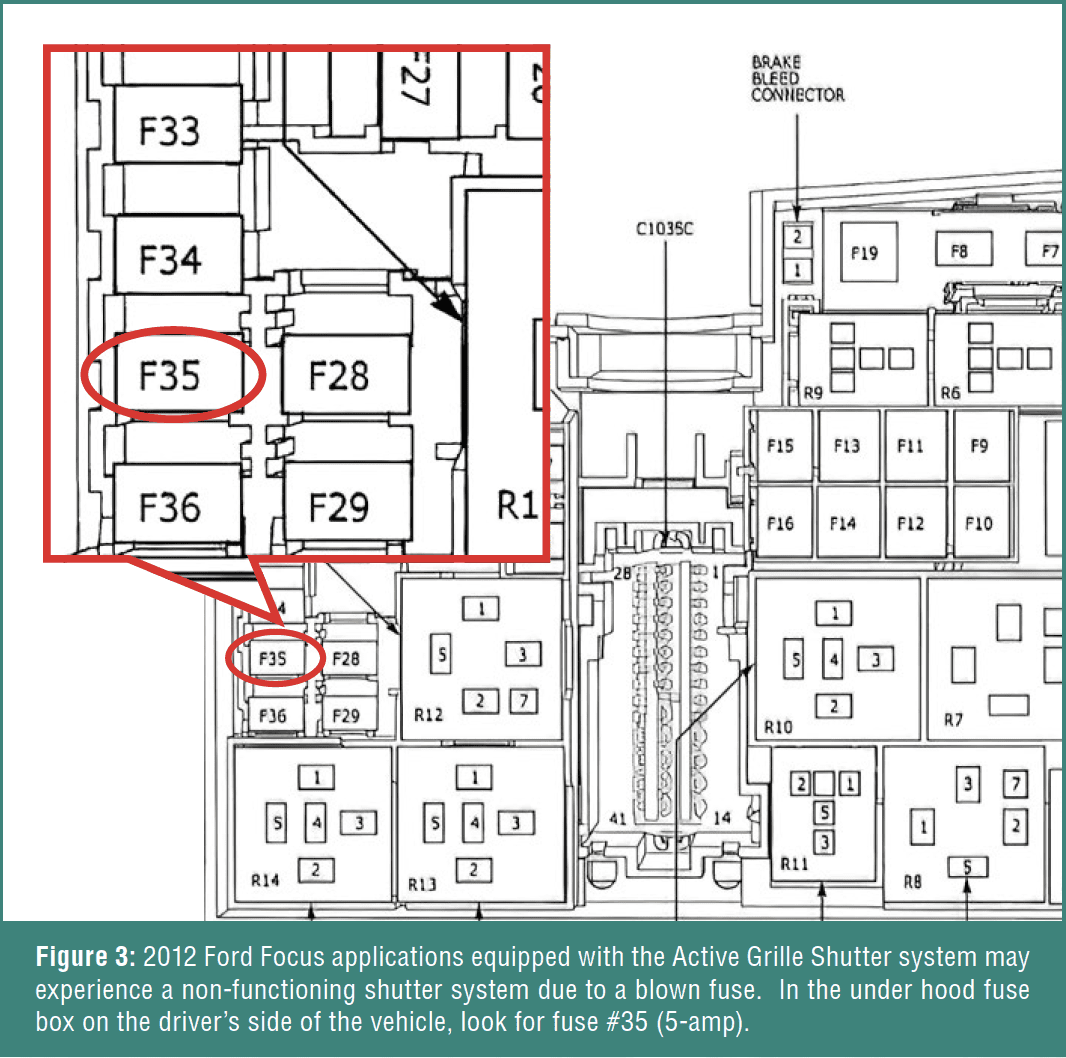
The Focus is a common vehicle equipped with shutters that shows up in transmission shops. From model year 2012-on, these vehicles had active shutters as an option. Unfortunately, a common problem on these is a blown fuse causing the shutters not to operate. Fuse #35 is a 5-amp fuse specifically for the Active Grille Shutter system (figure 3). Check for this fuse, replace it as needed, and diagnose for faulty shutter operation. Then, again, repair or replace as needed.
Stellantis (Mopar): Dodge RAM trucks have used active grille shutters since 2013. In 2019, they added an active air dam that deploys when the vehicle reaches 35 mph!
These two items reduce the drag on the truck enough to improve the fuel mileage by over 1 mile per gallon, a significant milestone for a full-size truck. In addition, Dodge Dart and Chrysler 200 are two car models that have active grille shutter systems.
A disabled remote start system is directly connected to active grille shutter issues with the RAM applications. Do not be quick to replace the shutter assembly before diagnosing thoroughly. On 2019 and later models equipped with the deployable air dam, it is common for the dam to be damaged by striking parking barriers. Inspect and repair as needed.
Honda: The Honda Odyssey and CR-V have had active grille shutters since 2017. The CR-V has an upper and lower shutter that acts together. When the vehicle starts, the shutters cycle from open to closed, then back to open. The shutters are commanded open when the vehicle is turned off. Ambient and vehicle operating temperatures and other related sensors determine if the shutters are commanded open or closed. For example, the initial start in the morning requires the engine and transmission to reach operating temperature. So, to expedite this process, the shutters are commanded to be closed to restrict cooling airflow, allowing the vehicle to achieve optimal temperature quickly.
When the active grill management system cannot operate the shutters or determine the position, the PCM commands a “reduced power” operating mode to prevent the engine and transmission from overheating. Note that faults in the shutter operation must be corrected to restore the vehicle operation to full power mode!
Nissan: The Nissan Murano has an active grille shutter system below the front bumper only. The computer system also monitors A/C refrigerant pressure and cooling fan status (on or off) to modify shutter operation. Failsafe operation commands the shutter open. The system will function by PCM commands provided the following conditions are met:
- No CAN communication faults
- No engine coolant temperature sensor faults current or stored
- No engine oil temperature sensor faults present or stored
- No vehicle speed sensor faults current or stored
When all the conditions mentioned above are met, the shutter is commanded to close around 35 mph. If vehicle speed reaches 88 mph or greater, the shutters are controlled open to prevent air pressure at higher speed from locking the shutters in the closed position. This strategy also ensures adequate cooling under higher engine load demand.
 WHEN THINGS GO WRONG
Of course, we don’t live in a perfect world, so what issues do we see with these systems that may affect our transmission or an initial diagnosis coming into the shop? The main problem we have observed so far comes from vehicles that suffered front-end damage. Since the mechanism is located behind the grille (on most models), it is subject to being harmed. A single damaged shutter vane can render the whole assembly useless. Even worse, if the damage is mild and barely detectable, a damaged shutter assembly may be left inadvertently unrepaired by a body shop.
Problems here can affect the transmission warm-up and cooling. A damaged shutter assembly is especially problematic on vehicles with variable opening systems. Here, the system can appear to function correctly but may lack the full range of movement. Of course, if it sticks open, the only issue would be the loss of the aerodynamic advantages and a quick warm-up. However, transmission and engine overheating will occur if it restricts the airflow too much or gets stuck shut.
Also, note that other vehicle functions may be limited or disabled due to faults in the active shutter system. Earlier, we mentioned a few from different manufacturers. Refer to manufacturer specifications and diagnostic trouble codes to indicate specific failure management action taken by the vehicle programming.
The active shutter system may fail due to exposure to severe weather conditions. Ice and snow buildup can obstruct the shutters preventing them from opening and closing. Shutters stuck closed can cause a vehicle to overheat driving down the highway at freezing temperatures! They can also fail to operate due to corrosion. In the northeast, in the wintertime, many areas use salt on the roadways to melt ice and snow. As a result, vehicles are exposed to a saltwater spray kicked up by traffic. Since the shutters are in front of the vehicle, the salt water works its way into the moving parts compromising the lubrication. It is a recipe for future failure.
WHAT TO DO NEXT?
When you identify a vehicle in your shop with shutters, you must ensure that the system works as designed. Refer to manufacturer specifications when needed. If the system is disabled or not working correctly, indicate the condition on the initial vehicle inspection worksheet. The documentation will be invaluable to guard you against customer complaints, especially in areas where vehicles are subjected to emission inspections. The active shutter system is considered an emission-related system!
Note that repair components are not only available from the OEM, but several aftermarket manufacturers make them too. Most major parts houses have parts listings for domestic and foreign vehicles equipped with active shutter systems.
Diagnosing common transmission complaints on late model vehicles can be tricky. Adding components that aren’t directly related to transmission operation must always be considered when searching for the root cause of failures. Never dismiss the most remote possibilities but always ask yourself could this be the cause? By doing this, you can deliver the vehicle correctly the first time!